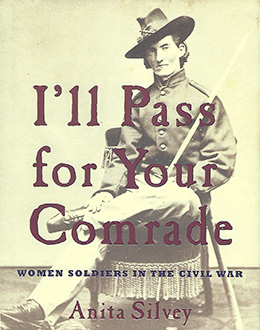
I’ll Pass for Your Comrade
Women Soldiers in the Civil War
The Civil War has been studied, written about, even sun about for generations. Most people know that it was a conflict between North and South, Unionists and rebels, blue and gray. We recognize the names of Jefferson Davis, Ulysses S. Grant, and Robert E. Lee. Many people know about Clara Barton, the nurse who did so much to save soldiers’ lives.
However, few have heard of Sarah Emma Edmonds, Rosetta Wakeman, or Mary Galloway. They were among the hundreds of women who assumed male identities, put on uniforms, enlisted in the Union or Confederate Army, and went into battle alongside their male comrades.
In this compelling book, Anita Silvey explores the fascinating secret world of women soldiers: who they were, why they went to war, how they managed their masquerade. A few left memoirs, diaries, or letters. Newspaper stories, pension records, and regimental accounts yielded additional information, as did the writings of male soldiers who became aware of the women in the ranks. Undoubtedly, there were women soldiers whose true identity was never discovered or revealed.
Accessible, accurate, and engaging, I’ll Pass for Your Comrade invites readers to view the Civil War from an uncommon perspective and explores an often overlooked aspect of our history.
Reviews
“In her first book for young readers, children’s literature expert Silvey introduces unsung heroes of the Civil War: women who risked their reputations and lives to fight as soldiers. The volume, containing excerpts from first-person accounts and abundant vintage photographs and etchings, explores the motives, adventures and day-to-day struggles of women who shed their skirts and cut their hair to pass as male enlistees. In highly accessible language, the author shares enough background to enable readers to put into context pre-Victorian restrictions on women. At the same time, she captures the fiery spirits of unconventional individuals. Representing more than 30 years of the author’s passionate interest in the Civil War, Silvey’s is an engrossing, intelligently wrought account of 19th-century feminists making their mark.” (Publishers Weekly, starred review)
“While previous books for young people have profiled women who served as nurses and spies during the Civil War, this one spotlights Union and Confederate women who fought on the battlefields. Why these women fought; what their lives were like; how they hid their identities; how they fared in hospitals, in prisons, and in two significant battles; and what they did after the war ended are all topics that are covered. Readers will appreciate attention to mundane questions such as how women with so little privacy dealt with menstruation. Throughout the book, Silvey shows that though the women discussed all fought in the same war, their backgrounds, motivations, and experiences varied widely. Period photos, prints, drawings, and documents are among the many illustrations. Back matter includes source notes and a list of books, articles, and archival materials. Well researched and clearly written, this attractive book illuminates an aspect of the Civil War that is often overlooked.” (Booklist)
“While previous books for young people have profiled women who served as nurses and spies during the Civil War, this one spotlights Union and Confederate women who fought on the battlefields. Why these women fought; what their lives were like; how they hid their identities; how they fared in hospitals, in prisons, and in two significant battles; and what they did after the war ended are all topics that are covered. Readers will appreciate attention to mundane questions such as how women with so little privacy dealt with menstruation. Throughout the book, Silvey shows that though the women discussed all fought in the same war, their backgrounds, motivations, and experiences varied widely. Period photos, prints, drawings, and documents are among the many illustrations. Back matter includes source notes and a list of books, articles, and archival materials. Well researched and clearly written, this attractive book illuminates an aspect of the Civil War that is often overlooked.” (Booklist)
“Silvey carefully documents a little-known side to the Civil War: the hundreds of women who fought for both sides. Some worked in traditional positions such as camp laundresses and only picked up arms when unexpectedly under fire, but this narrative focuses on women who posed as men in order to fight. Some did so to remain with a beloved husband or brother, but others sought glory, excitement or simply the chance to make money. The large number of boys in the armies made it relatively easy for women to “pass.” Many fought well; some died in battle. A few even received pensions in their old age. Beginning with Bull Run, the neatly organized text explores the reasons for enlisting, how the women went about it, life as a soldier, Antietam, hospitals and prisons and, finally, what happened to them afterward. Folding in quotations from a wealth of primary sources and punctuated by period illustrations and photographs, the narrative takes readers to the battlefields for an immediate experience of combat. A valuable resource.” (Kirkus Reviews)
“Female Civil War soldiers (disguised as men) weren’t as rare as the history books might have you think. Former Horn Book editor Silvey’s first book for young people explores this little-known chapter of history with numerous primary source references and thought-provoking commentary. Why did these women fight? How did they pass as men? How did they hold up to the daily life of a soldier … and the heat of the battlefield? And how did these remarkable women transition back into civilian life after the war? Given the relative dearth of material on female Civil War soldiers, it’s to Silvey’s credit that she is able to build an engaging social history in answer to these questions, interspersing solid factual exposition with colorful vignettes and period illustrations and photographs. The broader contexts of the war and the societal mores of the time give additional resonance to this well-researched portrait of brave, unconventional women. As Loreta Janeta Velazquez reminisced, “I would not have missed it for the wealth of the world, and was more than repaid for all that I had undergone, and all the risks to my person and my womanly reputation that I incurred, in being not only a spectator, but an actor, in such a sublime, living drama.” (The Horn Book)