

Clarion Books, 2016
Buy the Book
Resources
Let Your Voice Be Heard
The Life and Times of Pete Seeger
“What children’s book changed the way you see the world?”
Anita Silvey asked this question to more than one hundred of our most respected and admired leaders in society, and she learned about the books that shaped financiers, actors, singers, athletes, activists, artists, comic book creators, novelists, illustrators, teachers …
The lessons they recall are inspiring, instructive, and illuminating. And the books they remember resonate as influential reading choices for families. This book, with its full color excerpts of beloved children’s books, is a treasury and a guide: a collection of fascinating essays and an excellent gift choice for families.
This book is ideal for family discussions, book clubs, and One Community Reads programs. All ages of readers will enjoy talking about the book that has most influenced their lives … even six-year-olds!
Awards and Attention
- Booklist Top 10 Biographies for Youth 2017
- Bookology Magazine, Essential Holiday Giving: Books
- Children’s Book Review, Best New Kids Books
- Publishers Weekly, Post-Election Reading: Bookseller Picks
- Washington Post Best Children’s and YA Books of the Month
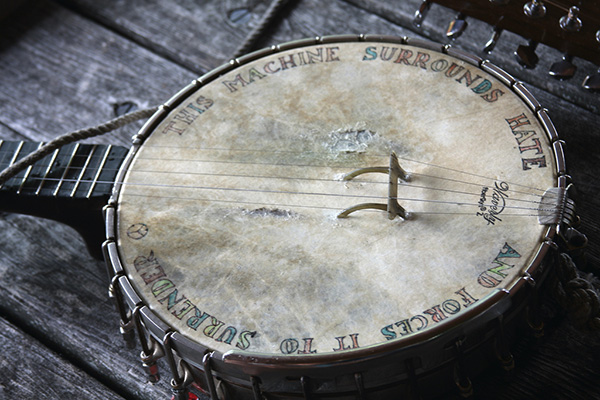
imprinted on Pete Seeger’s banjo
Reviews
“This informative biography introduces folksinger and activist Pete Seeger, whose privileged family gave him a love of music, an awareness of social inequities, and a determination to challenge injustices. Mentored by Alan Lomax and Woody Guthrie, he played banjo while singing traditional and original songs. After serving in WWII, he performed with the Weavers, who were targeted by the House Un-American Activities Committee in the 1950s. Seeger’s principled response to the committee is legendary, but more important in the long run was his day-to-day life during those years. Blacklisted, he crisscrossed the country playing at schools and colleges, building a fan base of young idealists who loved folk songs. And the rest is history, recorded here in succinct accounts of Seeger’s activism in Vietnam War protests, the civil rights movement, and the environmental cleanup of the Hudson River. Illustrated with photos, this well-researched account of Seeger’s life makes excellent use of primary source materials. Silvey may not be the first to call Seeger “the Johnny Appleseed of folk music,” but she makes a strong case for the title and, along the way, explains some facets of American history that may be new to children. A lively, unique contribution to the biography shelves.” (Booklist, starred review)
“Pete Seeger became the most important folk singer of the twentieth and twenty-first centuries. But he might have chosen a very different path.” In addition to abundant primary source material, Silvey makes terrific use of her access to her subject, who died in 2014 at age ninety-four, and tells his sometimes complicated story with clarity and gusto. To elucidate a career spanning seven decades, Silvey covers Seeger’s privileged, mildly eccentric upbringing; his trial-and-error path to folk singing (he first tried journalism, then painting — both unsuccessfully); his complex friendship with Woody Guthrie, who taught him how to become a performer, not just a singer; his rising fortunes as a member of the chart-topping folk group the Weavers; his targeting during the Communist witch hunts of the 1950s (being called to testify before the House Un-American Activities Committee), which sank the Weavers’ careers; and his subsequent reinvention as a solo artist who entertained all ages. Rushed here are Seeger’s last decades (when he became a crusader for the environmental movement), but this is a mere quibble about a book whose author has an expert’s ear for the interests of her intended audience (including that fact that Seeger once got paid in hamburgers). Scattered throughout are black-and-white photos, many of which capture Seeger’s charisma and the joy he took in music. Appended with extensive back matter, including source notes, a bibliography, and an index.” (The Horn Book)
“In her admiring portrait of Pete Seeger (1919–2014), Silvey presents clearly the folk singer and activist’s passionate commitment to music and social justice. After a privileged upbringing and two years at Harvard, Seeger “acquired an encyclopedic repertoire of folk songs” while working at the Archive of American Folk Song. He began playing banjo with Woody Guthrie in 1940 and devoted his life to singing for causes he considered just: organized labor, civil rights, and environmental and antiwar campaigns. After establishing Seeger’s success as a singer, Silvey devotes a chapter to his commitment to the environment (specifically, cleaning up the Hudson River), then jumps from the early 1970s to the 2009 inauguration of President Obama. Silvey provides well-supported, well-rounded context for Seeger’s moral stances, personal life (including his wife’s supportive role as his manager), and enduring claim to folk-song fame with such influential contributions as “Abiyoyo,” “Where Have All the Flowers Gone?” “Guantanamera,” “Michael, Row Your Boat Ashore,” and “We Shall Overcome.” Archival photographs, source notes, and a bibliography are included.” (Publishers Weekly)
“Silvey traces the influences and happenings that would take Pete Seeger, born to classical musician parents, from a place of wealth down to the union halls, small towns, and never-ending crusade against injustice. Seeger is shown learning from the likes of Alan Lomax and Woody Guthrie and coming to understand economic inequality, workers’ rights, and civil rights. To bring the message of folk music and peace to a greater audience became Seeger’s — and by extension this book’s — quest. Through personal interviews, as well as primary source materials, Silvey creates a flowing biography for the middle school audience. She succeeds in portraying the strength of the singer’s convictions, even in the face of adversity, which included a 10-year persecution by the House Un-American Activities Committee. Each chapter begins with a verse from Seeger’s repertoire of music — some original and others renditions of traditional songs. VERDICT The subject is presented in such a way that readers will feel close to Seeger and be inspired to pursue more information on him and the causes he fought for.” (School Library Journal)
“Folk singer Pete Seeger (1919–2014) performed live for millions of people, but how many preteens know of him now? With the engaging, well-illustrated biography Let Your Voice Be Heard: The Life and Times of Pete Seeger, author Anita Silvey explains how this unlikely folk-music hero turned singalongs into social change. One of his colleagues in the Almanac Singers once said of Seeger: “He wasn’t the greatest banjo player, he didn’t have the greatest voice, but there was something catchy about him.” Silvey locates that appeal in Seeger’s enthusiasm for his audiences and the folk songs he performed. Instead of flooding readers with details, she emphasizes Seeger’s mentors, most influential songs (such as “If I Had a Hammer” and “Turn, Turn, Turn”), and the movements he helped galvanize. Seeger’s pro-labor activities and onetime membership in the Communist Party got him summoned before the House Un-American Activities Committee, and his active roles in the civil rights and antiwar struggles of the ’60s brought him further trouble. But he kept on taking on big causes, most visibly with a cleanup campaign that included helping kids to sail on — and better appreciate — the Hudson River. Perhaps a young reader will be moved to write a folk song about him. (Washington Post)